Canine pain assessment after orthopedic surgery is one of the most consequential clinical tasks I perform in a rehabilitation setting. Get it wrong in one direction and you undertreat a patient who is suffering silently. Get it wrong in the other direction and you push a dog through progressive loading protocols before the tissue is ready. Either error sets recovery back by weeks. The Glasgow Composite Pain Scale gives me a structured, validated framework to anchor my observations, but after 15 years of hands-on canine rehabilitation, I can tell you that the scale alone does not tell me enough. What I am describing here is not a critique of the Glasgow instrument. It is a working explanation of how I build a complete pain picture in every post-operative session.
Why Glasgow Is a Starting Point, Not a Finish Line
The Glasgow Composite Measure Pain Scale, developed at the University of Glasgow's veterinary school, remains one of the most rigorously validated pain scoring tools in small animal practice. The short-form version covers six behavioral categories including vocalization, attention to wound, mobility, response to touch, demeanor and posture. Each category produces a subscale score and those combine into a total that guides analgesia decisions. I respect the instrument and I use it consistently.
The challenge is context. The scale was developed and validated in acute hospital settings, typically within the first 24 hours post-operatively. A dog presenting to a rehabilitation session four days after tibial plateau leveling osteotomy surgery, or two weeks after a femoral head and neck excision, is in a fundamentally different physiological and behavioral state than the acute hospitalized patient the scale was built around. The nociceptive profile has shifted. Wind-up sensitization may be present. Compensatory guarding patterns have had time to consolidate. The dog has also adapted psychologically to the hospital or clinic environment, which changes how behavioral indicators present.
I treat the Glasgow score as my anchor point at session intake. It gives me a number I can trend over time and communicate to the supervising DVM in a language that is standardized and defensible. Then I start watching everything else.
Behavioral Markers I Track in Every Rehab Session
The behavioral markers I have found most clinically informative are not always the dramatic ones. A dog vocalizing during palpation is obvious. What is less obvious, and often more diagnostically useful, is what I see before I ever touch the patient.
Weight-bearing symmetry during static stance is the first thing I observe. I position the dog squarely on a level surface and watch for subtle unloading of the surgical limb. A dog that shifts weight laterally toward the contralateral pelvic limb during quiet standing is communicating something the Glasgow score may not capture, especially if the dog is otherwise compliant and non-reactive during handling.
Gait quality during free movement in the rehabilitation space tells me about dynamic pain behavior. I watch for abbreviated stride length, toe-touching without full weight acceptance, exaggerated truncal sway that offloads the surgical side, and a shortened cranial phase of swing. These are kinetic compensations that develop when a patient is managing nociceptive input across the gait cycle.
Response to passive range of motion is another primary indicator. I flex and extend the surgical joint through its available range slowly, maintaining consistent pressure, and I watch for the earliest sign of resistance. That resistance, whether it is a subtle increase in muscle tone around the joint, a head turn toward the limb, or a shift in breathing pattern, tells me where the comfortable range ends and the painful range begins. That boundary moves session to session and I document it precisely.
Spontaneous movement quality matters as well. Does the dog transition from sit to stand with normal hip extension, or does it scramble to its feet in a way that protects the surgical limb? Does it shake off and reposition during a rest break in a way that reflects normal comfort, or does it hold a guarded posture even at rest? These are low-cost observations that take thirty seconds and deliver high-value data.
Reading Canine Facial Action and Postural Cues
The Canine Grimace Scale, developed from work published in PLOS ONE by Sotocinal and colleagues, introduced a standardized approach to reading facial action units as pain indicators in dogs. The five action units are orbital tightening, ear position, muzzle tension, whisker change and head position. I do not score the Canine Grimace Scale formally in every session, but the framework has fundamentally changed what I look for when I watch a patient's face.
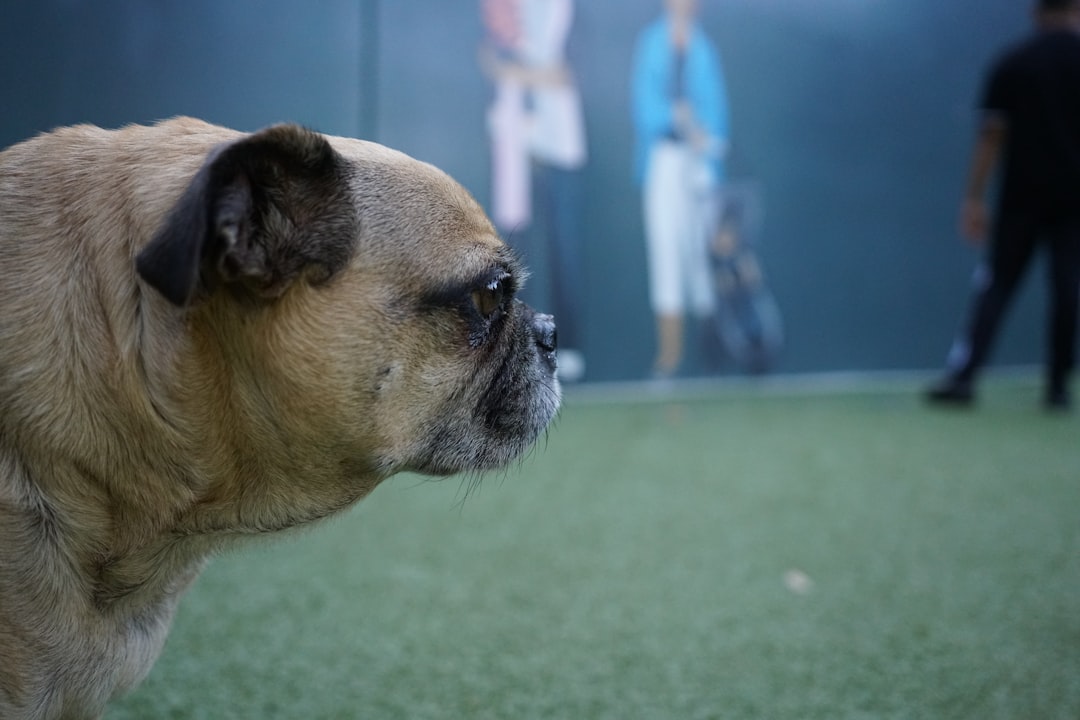
Orbital tightening, the partial squinting of the eyes, is one of the most consistent facial indicators I observe in patients with unmanaged post-operative pain. It is subtle enough that owners frequently miss it entirely, especially in dark-coated dogs or dogs with heavy facial folds. I look for it specifically during moments of joint loading, during the transition between exercises, and during passive range of motion assessment.
Ear position in combination with muzzle tension creates what I mentally code as a pain face. The ears rotate caudolaterally, the muzzle draws slightly tight around the nares and commissures, and the overall expression flattens. This expression is distinct from fear or anxiety, though those can co-occur and complicate interpretation. Learning to distinguish a dog that is in pain from a dog that is fearful of the clinical environment is a skill that develops over years of observation, and it is one of the reasons hands-on rehabilitation experience matters so much in this field.
The Real Limits of Owner-Reported Pain Scores
Most post-operative rehabilitation protocols include some form of owner pain diary or home pain score sheet. I support using these tools because they capture information from the environment where the dog spends most of its time. I cannot observe a dog at 2 AM when it shifts repeatedly on its bed, or watch how it responds to getting up after three hours of rest, or see how it reacts when another dog in the household bumps against the surgical limb. Owners can. That data is genuinely useful.
The limitation is observer bias, and it runs in both directions. Owners who are anxious about their dog's recovery or who are experiencing guilt around the surgical decision tend to rate pain higher than my clinical observations support. Owners who have strong emotional investment in seeing their dog recover, or who have been waiting months for the dog to return to function, tend to minimize pain indicators and under-report. Neither group is being dishonest. They are being human.
I treat owner pain reports as directional information that flags whether the home environment is consistent with what I observe in the clinic. A large discrepancy in either direction is itself a clinical signal. If an owner reports a pain score of eight out of ten at home but the dog presents to the session relaxed, full weight-bearing and voluntarily exploring the rehab space, that gap needs investigation, not averaging. It might mean the dog has breakthrough pain at specific times of day that correlate with medication wear-off. It might mean the scoring tool was not adequately explained. It might mean the owner is observing something real that the clinical setting is masking because the dog performs well under stimulation.
I document owner scores, note the discrepancy when one exists and communicate it to the supervising DVM with my own clinical observations attached.
Pain Masking in Stoic Breeds and High-Drive Dogs
Breed-associated pain masking is a phenomenon I think about constantly in orthopedic rehabilitation. Labrador Retrievers are the most common post-operative patient I see for CCL repair, and they are also among the most motivationally compliant dogs I work with. A food-motivated Labrador will perform every underwater treadmill repetition, every balance board exercise, every proprioceptive challenge I present, and it will do so with apparent enthusiasm even when it is in significant discomfort. The willingness to engage is not evidence of the absence of pain.
Working-line Belgian Malinois and Dutch Shepherds present a similar challenge in the sports medicine population. These are dogs bred for drive and pain tolerance, and their threshold for displaying overt behavioral pain indicators is genuinely higher than in many other breeds. The Glasgow Composite Pain Scale applied to a high-drive Malinois two weeks post-TPLO may return a score that suggests mild discomfort when the underlying nociceptive load is substantially higher.
With these patients I rely more heavily on physiological indicators, focal heat mapping around the surgical site using the dorsum of my hand, any asymmetry in muscle tension during bilateral palpation of the quadriceps and hamstring compartments, and the specificity of their response to direct palpation over the repair site versus adjacent structures. A dog that is pain-masking behaviorally will still flinch when you hit the right spot with the right pressure.
I also watch what happens immediately after a session when the dog is off-leash in a controlled space and the performance pressure of the exercise is removed. That is often when the guarding patterns that were suppressed by arousal become visible again.
When I Escalate to the Supervising DVM
My scope of practice as a CCRA is clear. I perform rehabilitation under veterinary supervision. I do not diagnose and I do not adjust medication protocols. What I do is observe with precision, document with specificity and communicate findings to the DVM in a format that enables them to make informed clinical decisions quickly.
I escalate without delay when any of the following conditions are present. First, when behavioral pain indicators during the session directly contradict the formal Glasgow score. A dog scoring in the mild range on the scale while displaying orbital tightening, active weight-shifting away from the surgical limb, and resistance to passive range of motion at less than forty degrees of flexion is not a mild pain patient in my assessment. That contradiction is itself the clinical finding.
Second, I escalate when I observe a regression in weight-bearing or mobility after a documented period of improvement. A dog that was accepting full weight at session four and is toe-touching again at session six is telling me something has changed. That might be an implant concern, a soft tissue complication, a change in the home exercise program that overloaded the repair, or an analgesic protocol that is no longer meeting the patient's needs as activity increases. The DVM needs to make that determination, not me.
Third, focal heat, new swelling or a change in the quality of palpable tissue around the surgical site goes to the DVM immediately. These are not rehabilitation findings. These are clinical findings that require a medical response.
Fourth, when a patient's pain behavior is severe enough that continuing the session as prescribed would not be in the patient's welfare interest, I stop. I do not push through. I document what I observed, I notify the supervising DVM before the next session and I adjust the protocol only within parameters the DVM establishes in response to my communication.
Pain assessment in post-operative canine rehabilitation is a continuous clinical process, not a checkbox at the start of a session. The Glasgow Composite Pain Scale gives me language and structure. Fifteen years of observation give me context. The combination of both, communicated clearly to the veterinary team, is what actually serves the patient. That is the standard I hold myself to in every session.