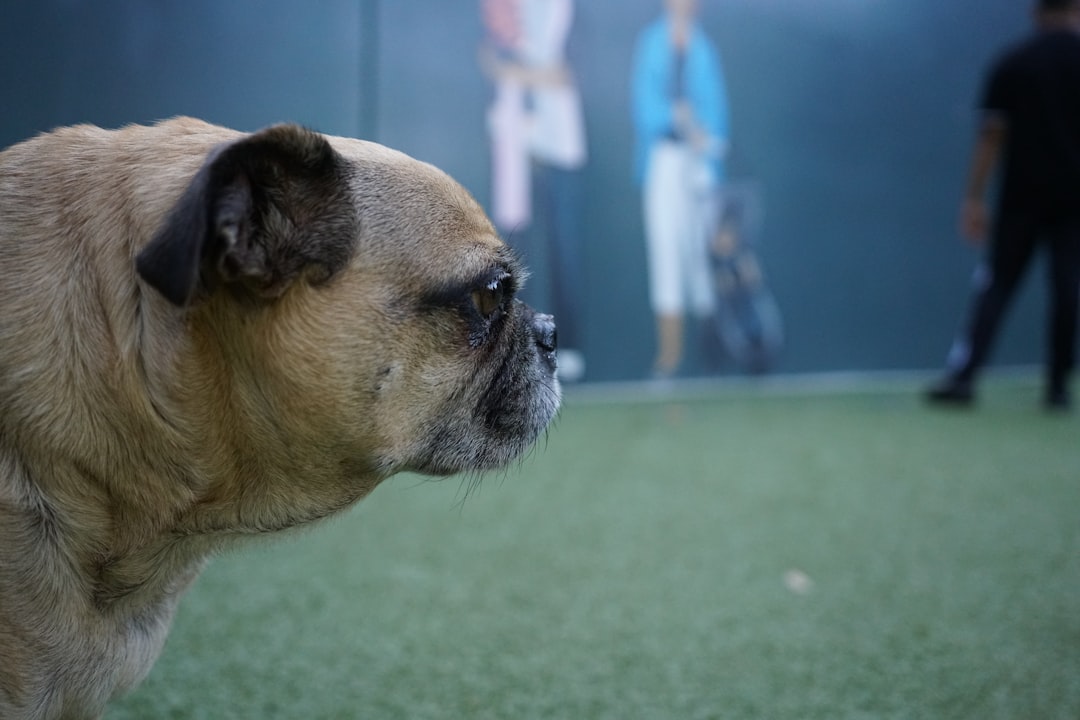
Every rehabilitation session I run on a post-operative orthopedic patient starts before I put a hand on the dog. I am watching from across the room. I am watching how the dog holds its weight while standing, how it transitions from sit to stand, whether its eyes are soft or tight, whether it tracks me with curiosity or disengages. None of that is on the Glasgow Composite Pain Scale. All of it tells me something critical about canine pain assessment that a paper scoring tool cannot capture alone.
The Glasgow Composite Measure Pain Scale short form, validated through the University of Glasgow's work, is genuinely useful. I use it. My supervising DVMs rely on it for analgesic decision-making and discharge planning. But in the context of a canine physical rehabilitation session, where I am spending 45 minutes to an hour with a post-TPLO patient or a dog recovering from hemilaminectomy, the scale is a floor, not a ceiling. What I build on top of it is where the real clinical picture emerges.
Why the Glasgow Scale Is a Starting Point
The Glasgow Composite Pain Scale short form scores six behavioral categories: vocalization, attention to wound, mobility, response to touch, demeanor and posture. Each category is anchored with descriptors. The total informs analgesic protocol adjustments, usually at a threshold around five out of twenty-four for the short form. It was designed for clinical triage and hospital observation, not for the granular behavioral arc of a rehabilitation session.
That design matters. When a veterinary technician does a quick Glasgow assessment in a hospital ward, they are capturing a snapshot. In rehabilitation, I am capturing a film. A dog may score a three on the Glasgow at the start of a session because it is resting comfortably in a kennel with adequate analgesia on board. That same dog may show clear signs of discomfort thirty minutes into an underwater treadmill session or during manual joint mobilization that the Glasgow never accounted for.
The scale also has a floor effect for stoic breeds. I work regularly with Labrador Retrievers, Rottweilers and German Shepherd Dogs after TPLO or tibial tuberosity advancement procedures. These breeds are notorious for masking pain expression. A stoic Lab may score a two or three on the Glasgow while exhibiting significant muscle guarding and avoidance behavior that only becomes apparent during hands-on assessment.
None of this is a criticism of the scale. It reflects what validated psychometric tools always reflect: they capture what they were designed to capture, within the context they were validated for. My job in rehabilitation is to extend that foundation with structured clinical observation.
Behavioral Markers I Track in Every Rehab Session
Before I touch a post-operative patient, I run a structured observational protocol. It takes about three to five minutes and it tells me more about where the dog's pain state is than any single score.
The first thing I look at is spontaneous facial expression. Research out of the University of Montreal and subsequent validation work produced the Dog Grimace Scale, which scores orbital tightening, ear position, muzzle tension, whisker and cheek tension, and head position. I do not always formally score the Dog Grimace Scale, but I use its framework. Tight orbital musculature on a post-TPLO dog at day fourteen, when you expect them to be trending toward comfort, is a flag.
I also watch for:
- Spontaneous postural shifts that suggest offloading, particularly three-legged standing when the dog believes no one is watching
- Licking or chewing at the surgical site or at locations distant from the incision, which can indicate referred discomfort or neuropathic pain components
- Reduced exploratory behavior in a dog that historically shows curiosity in the rehab environment
- Changes in respiratory rate or character at rest, particularly shallow thoracic breathing instead of normal diaphragmatic respiration
- Exaggerated startle responses to sound or movement in the room
- Reluctance to accept treats that the dog normally takes eagerly, which is one of my most reliable early pain indicators
That last point deserves emphasis. In my clinical practice, a dog refusing its normal high-value treat reward during a session is almost always a pain or nausea signal, not a training issue. When a post-operative patient who was enthusiastically taking chicken at the previous session suddenly turns away from it, I stop what I am doing and reassess before continuing any exercise protocol.
Gait Asymmetry and Weight-Bearing as Pain Proxies
Limb-use scoring systems like the Canine Orthopaedic Index and objective gait analysis using force plate or pressure walkway technology give us quantitative loading data. In practices with access to pressure walkways, those objective measures are gold standard for tracking post-operative recovery trajectories.
Many rehabilitation settings, including environments I have worked in throughout my career, rely on visual gait assessment and subjective limb-use scoring when pressure walkways are not available. Visual lameness grading on a 0-to-5 scale remains clinically relevant when applied consistently by a trained observer. What I add to that is a specific focus on compensatory patterns that often precede observable lameness.
Head bobbing in a dog with hindlimb orthopedic pathology tells me the dog is loading the forelimbs to offload pain in the rear. Contralateral hindlimb overloading, where I can see the dog pushing weight toward the non-operated side, suggests the operated limb remains more painful than the owner or standard assessment captures. Pelvic hiking during the swing phase of the operated limb often indicates hip flexor tightness secondary to guarding rather than true neurological involvement.
These compensatory patterns matter beyond pain assessment because they predict secondary injury risk. A dog three weeks post-TPLO that is consistently offloading to the contralateral stifle is at elevated risk for contralateral CCL pathology over time. Catching that compensation pattern early, through careful pain-driven gait analysis, lets me communicate it to the supervising DVM and adjust the rehabilitation protocol before secondary problems develop.
The Limits of Owner-Reported Pain Scores
Many rehabilitation programs, including multi-visit post-operative protocols, incorporate owner-reported pain or comfort scores collected between sessions. The Helsinki Chronic Pain Index and various practice-developed questionnaires ask owners to rate their dog's mobility, appetite, sleep quality, activity level and social engagement. This information is genuinely valuable because owners observe the dog in the home environment across a full 24-hour cycle, something I cannot do in a clinical setting.
I depend on that owner data. I ask for it at every session. I track it across visits.
I also know it has significant limitations that I have to actively account for.
Habituation bias is the most clinically consequential limitation. Owners adapt to watching their dog compensate. A dog that has been three-legged-standing intermittently for ten days starts to look normal to the person living with it. I see it constantly. An owner reports a pain score of two out of ten at day eighteen post-TPLO and I watch the dog arrive at the facility holding the operated limb off the ground in the parking lot. The owner is not being dishonest. They have adapted to what they see every day.
Anthropomorphism cuts both directions. Some owners project human emotional states onto behavioral changes and overestimate pain scores based on the dog seeming sad or clingy, when those behaviors may reflect boredom during activity restriction rather than nociceptive pain. Other owners minimize scores because they do not want to believe their dog is suffering, or because their previous dogs were stoic and they use that as a reference point.
My approach is to treat owner-reported scores as directional data rather than absolute measures. A worsening trend in owner scores over consecutive days, even if the absolute numbers are low, is worth taking seriously. A stable or improving owner score that contradicts what I observe in session is worth investigating rather than dismissing the owner's report.
What Manual Therapy Response Tells Me About Pain
Hands-on assessment during rehabilitation gives me a layer of pain information that neither the Glasgow scale nor owner reporting can access. Joint mobilization, soft tissue massage and passive range of motion assessment all generate pain-relevant behavioral responses that I read as I work.
Muscle guarding on palpation, the involuntary contraction of musculature overlying a painful region, is one of my primary intraoperative pain markers. I assess the quadriceps, hamstrings, iliopsoas and gluteal groups in every post-TPLO patient. Significant guarding in the iliopsoas on the operated side at day twenty-one, well past expected surgical site pain, suggests either inadequate analgesia reaching the muscle belly or developing secondary iliopsoas strain from the compensatory gait pattern. That finding goes directly to the supervising DVM.
I also track end-feel during passive range of motion. A soft end-feel that transitions to a hard, protective stop during stifle flexion at a range that should be comfortable by the current post-operative timeline suggests active pain rather than purely mechanical restriction. The distinction matters for protocol modification and for analgesic adequacy conversations.
Thermal changes on palpation, areas of focal warmth overlying joints or soft tissue structures, indicate active inflammation. I do not diagnose what is causing that warmth, but I document it and communicate it. A post-TPLO stifle at week four that feels significantly warmer than the contralateral stifle is not a finding I file away. It is a finding I report.
When I Escalate to the Supervising DVM
My scope as a CCRA is hands-on rehabilitation under veterinary supervision. I do not modify analgesic protocols. I do not diagnose complications. What I do is gather clinical information across extended contact time with the patient and communicate it effectively to the veterinarian responsible for medical decision-making.
I escalate immediately when I observe the following:
- Acute deterioration in weight-bearing or limb use compared to the previous session, particularly when there is no obvious explanation like increased activity at home
- Focal warmth, swelling or crepitus at or near the surgical site that was not documented at the previous visit
- Behavioral indicators of severe pain including unprovoked vocalization, extreme avoidance, or aggression from a dog with no prior aggression history in the rehab environment
- Respiratory rate elevation at rest that persists beyond the initial acclimation period
- Refusal to engage with the rehabilitation session despite appropriate warm-up and environmental adjustment
- Owner report of nighttime restlessness, interrupted sleep patterns or pacing, which can indicate breakthrough pain during periods of reduced activity
I also escalate when the trajectory does not match expected recovery milestones. If a dog three weeks post-TPLO is still scoring consistently high on behavioral pain markers when my supervising DVM and I would expect to see meaningful improvement, that pattern warrants a conversation about analgesic adequacy, possible implant complications or wound issues that imaging might clarify.
Clear, structured communication is everything in these escalations. When I contact the supervising DVM, I lead with the specific behavioral observations, the timeline, and how the current presentation compares to prior sessions. I do not lead with my interpretation of what might be causing it. The DVM needs my observations first and my impressions second.
Building a Complete Pain Picture in Orthopedic Rehab
The Glasgow Composite Pain Scale belongs in every post-operative pain assessment protocol. It provides a validated, reproducible baseline that creates communication consistency across the veterinary team. I am not arguing against it. I am arguing for it as one layer in a multi-modal assessment approach that also includes structured behavioral observation, gait and loading analysis, hands-on manual therapy response assessment and critically evaluated owner reporting.
In my fifteen years of experience working with post-operative orthopedic patients, the dogs who fall through pain assessment gaps are almost always the stoic dogs whose behavioral masking keeps their Glasgow scores deceptively low, combined with owners who have habituated to compensatory behavior and report comfort that the clinical picture does not support.
Rehabilitation practitioners have a meaningful advantage in catching these gaps because of the time we spend with each patient. A 45-minute underwater treadmill session creates observation opportunities that a brief hospital ward assessment cannot match. Using that time to build a structured, multi-dimensional pain picture, and communicating it clearly to the supervising DVM, is one of the highest-value contributions a skilled CCRA or CCRP brings to the post-operative care team.
For practitioners looking to deepen their pain assessment frameworks, the Canine Rehabilitation Institute and the American College of Veterinary Sports Medicine and Rehabilitation both offer continuing education resources directly relevant to post-operative pain management in rehabilitation contexts. The Veterinary Society of Surgical Oncology and broader surgical oncology literature also address perioperative pain in ways that translate to orthopedic rehabilitation practice.
Pain is not a number on a scale. It is a story the patient is telling you across every second of every session. My job is to listen to the whole story.